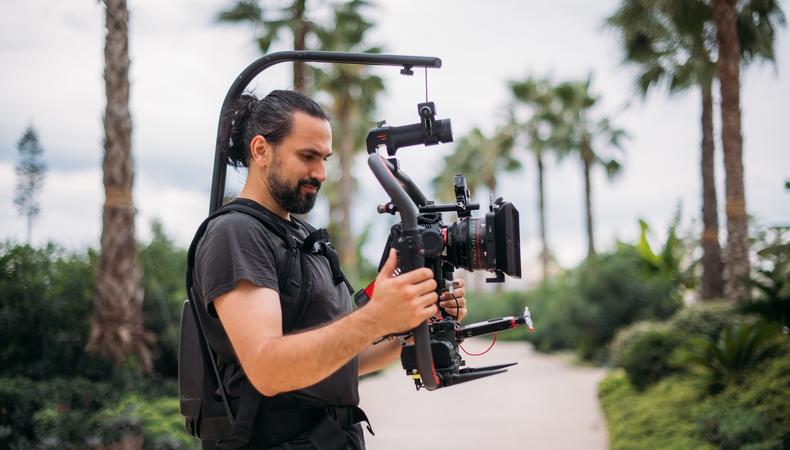
Video is not just a Hollywood feature anymore. Plenty of businesses and industries make content, such as commercials or social media—but you don’t need to be a cinematographer or have a fancy degree in order to do the work. Videographers capture these moments on film or digitally, aiding people the world over in bringing moving images to life. If you’ve ever wondered whether you could turn your camera skills into a full-time career, keep reading to find out more.
JUMP TO
Videographers film, produce, and edit video content. They are visual storytellers with the technical skills necessary to translate their—or their client’s—vision into engaging finished products. A videographer is often a one-person band, shooting, cutting, and broadcasting their work all on their own. They don’t just work in film and TV—videographers also make music videos, commercial advertisements, sponsored social media content, and vlogs. They work in the fashion industry, shoot weddings, and capture special moments in people’s lives. If there’s a need for video, there’s a need for a videographer.
“A videographer is someone who enjoys filming content and events,” explains filmmaker and producer Ayesha Fernandez, a New York Film Academy alum who works with creative production company Happy Monster. “Documentary films, YouTube videos, content for brands: all of it needs a videographer. It’s someone who enjoys the art of filming without necessarily having to tell a narrative story.”
Videographers are similar to cinematographers, but the latter role often requires more formal training and an emphasis on executing a creative vision in tandem with light, color, sound, and sets.
1. Research.
You can’t be a craftsperson without understanding your tools. Dive into the technical aspects of capturing video and using modern cameras. That means learning about everything from depth of field and framing to dynamic range and the best editing software for beginners. If you’re not ready to fully commit to a kit but want to play around with different gear, sites like ShareGrid let you borrow cameras and lenses for a few days.
2. Gear up and practice.
While a formal education is nice to have, it isn’t necessary to get the job done. “Thanks to technology, we have so many ways of being videographers,” Fernandez says. From cell phone cameras to mini DGs, “it doesn’t require as much equipment anymore.”
Get out in the world and start shooting things: nature, your friends, or random moments on the street. “Picking up a camera is the most important thing. Get a camera, get a good light, and start following people around, film a party, or film yourself,” Fernandez says. Find what interests you and chase it—literally or figuratively. “It’s such a technical job that everyone has to find their own way to do it.” The more you hone in on what your eye finds interesting and how you like to frame your shots, the better your skills will get and the more refined your eye and taste level will be.
But it’s not all about the camera. “Microphones, extra batteries, and a good attitude” are the most valuable assets to a videographer, adds Fernandez. “You have to be willing to help, to follow, and be interested in who [or] what you’re shooting.”
3. Build a portfolio.
Cut together a brief reel of your best work and create a homepage for it to live on. You can make a website, YouTube page, or even just use your social media as a proverbial calling card. Some people start out shooting things with their friends for free and then graduate to working on student films and other low-level productions as they build their résumé, portfolio, and on-the-job experience.
WATCH: Ayesha Fernandez - Director's Reel
However you decide to present your portfolio, just know that it represents you and your brand as a videographer, so make it look professional. At the end of the day, your portfolio is what’s going to get you work—not where you went to school or how many followers you have on social media. The more you finesse your eye and refine your point of view, the better chance you have to get hired.
4. Apply for bigger and better gigs.
Once you graduate from shooting your own work, seek out professional videographer jobs on Backstage, as well as on your local Facebook groups, LinkedIn, and crew-focused boards like Staff Me Up.
According to ZipRecruiter, the “majority of videographers make between $44,500 (25th percentile) to $73,000 (75th percentile).” Freelance gigs can average day rates of anywhere from $250 to $700 per 12-hour day, depending on your experience, the size and scope of the project, and if you come with your own gear. Spoiler alert: “It’s really helpful to have your own gear,” Fernandez says. Kit fees often help balance out your maintenance costs. Of course, when you’re just starting out, passion will need to pay for a lot. Nobody should work for a big company for free, but if your friend’s band’s new single makes you happy, maybe shooting that music video on the cheap is exactly what your portfolio needs.
In conclusion, if you’re looking to create content as a videographer, get out there and start making things. If you’re passionate and committed, you’ll learn as you go. Good luck!