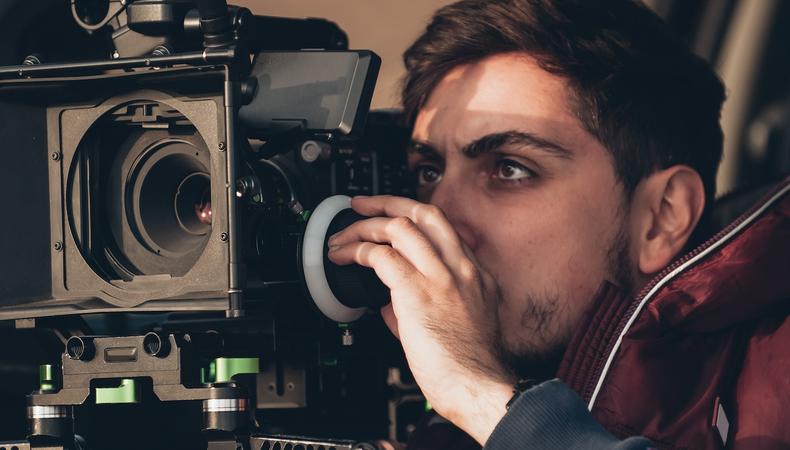
These days, you, too, can make your movies look like they were shot by Janusz Kamiński. Since the advent of the smartphone and equipment sharing, cinematography has become especially available to filmmakers at any budget level.
OK, maybe it takes a bit more than a nice camera and an understanding of basic lighting before you can claim your first Oscar (Kamiński has two, but who’s counting). The point is, advancing your skills can simply come down to studying the cinematic techniques that set apart the best from the rest. Do you know the difference between a close-up, a medium shot, and a long shot? An establishing shot and a P.O.V.? And what the hell is the “rule of thirds”? Let’s dig in.
Ready for your close-up
Perhaps self-explanatory, a close-up is a shot that is, well, close to the actor’s face. A close-up of an object is called an insert. These shots can be used for numerous reasons (especially if you decide to go extremely close): to zero in on facial expression, emphasize the walls closing in on a character’s world, or, in the case of Sergio Leone’s denouement for “The Good, the Bad and the Ugly” (1966), add tension to the much-anticipated climactic fight:
Medium shots vs. long shots
Don’t just point a camera at someone and hope for the best. How you intentionally frame your characters and the world they inhabit can tell the audience all they need to know without saying a word. Everything from body language and relationship dynamics to hidden threats and background gags can be conveyed through the many iterations of a medium shot, which captures your subject from the waist or knees to the top of their head. Perhaps, for example, you want to illustrate a closeness between two people within a vast background, as in this famous shot from James Cameron’s “Titanic” (1997).
Alternatively, you can use a long shot (also known as a wide shot) to really spotlight your setting, which in turn speaks volumes about your subject. Are they dwarfed by their surroundings? Completely at ease in the middle of chaos? Edgar Wright utilizes this to hilarious, ironic effect at the start of “Hot Fuzz” (2007):
Setting the scene
Establishing shots are also pretty self-explanatory: They are any frame that sets up where a scene takes place. But remember, every shot can communicate more than what meets the eye. Establishing shots may clue us in to time, place, and even tone. In Jean-Pierre Melville’s 1970 nihilistic masterpiece “Army of Shadows,” an establishing shot of the Arc de Triomphe with Nazi soldiers marching toward the camera lets us know that we are in Vichy France—and, symbolically, that liberty is being trampled upon.
A killer’s eyes: the P.O.V.
Point-of-view shots are something of a specialty these days, but don’t take them for granted. When British filmmaking maestro Michael Powell made “Peeping Tom” in 1960, arguably inventing the slasher subgenre, the P.O.V. had not yet been utilized to humanize an outright villain. It was as shocking then as it is now. Check out the opening sequence, here:
The rule of thirds—and, is it really a rule?
The rule of thirds, which is really more of a guideline if we’re honest, is a starting point for composing shots. Imagine a grid over a shot, with two horizontal lines and two vertical lines creating nine equal sections. The rule suggests that aesthetically pleasing images center the most important subjects—the places where you want your audience’s attention—along these lines or at the points where they intersect.
It is, ideally, a helpful guide to consider how to most impactfully capture what’s in front of the camera. At the end of Steven Spielberg’s semi-autobiographical “The Fabelmans” (2022), Sammy Fabelman (Gabriel LaBelle) visits the office of iconic Western filmmaker John Ford (played by legendary director David Lynch) for career advice. Ford’s one piece of guidance? Toy with the rule of thirds:
Track or treat
You’ve got your framing down and you’re being intentional with your shots. Now you have to demonstrate the same level of thought and care any time the camera moves. Tracking, dolly shots, freefloating Steadicam, and even unstable handheld work can amplify the tone and energy of a scene.
“I think the best dolly shots are the ones that don’t feel like dolly shots because you’re so engrossed in the action, the character, or the story,” director Jacob Reed (“Jimmy Kimmel Live!”) told Backstage. “Like any shot, I think the most important thing is that it feels motivated by what the audience is seeing and experiencing and amplifies that instead of just being a stylistic flourish.”
Known for his highly stylized, storybook filmmaking style, Wes Anderson is probably best known cinematographically for his expertly crafted tracking shots. Accomplished via a stable camera atop a moving platform (a “track”), the technique helps Anderson create the literary style that so informs his deadpan comedy-dramas. This video essay created by Focus Features highlights how “Moonrise Kingdom” (2012) in particular uses its palette to tell a story about two kids in love and on the run.
Lights! Camera! Both!
Of course, excellence in cinematography comes down to more than just camera movement—it also incorporates expert lighting. “I think the most important thing about cinematography is lighting. That’s how you create the mood that matches the story,” Oscar-winning cinematographer Vilmos Zsigmond (“Close Encounters of the Third Kind,” “The Deer Hunter”) told American Cinematographer. “The ability to light artistically is a gift from the gods.”
The film noir era of the 1940s and ’50s made chiaroscuro lighting a mainstay by using high-contrast black and white images to emphasize an air of secrets, lies, and hidden agendas.
In the early 2000s, the mumblecore movement in the States was defined by natural lighting captured in digital cinematography, perfect for an aesthetic of hyper-naturalism.
Recently, Greta Gerwig made the plasticity of Barbie’s world come alive through an artificial pink gloss that was reminiscent of the commercial world from which it was born.
Regardless of how you approach the process, your moviemaking will be best served by intentionality. The most expensive camera and lighting equipment in the world cannot save a lack of vision. Some of the best cinematography has been done on iPhones, as Sean Baker famously did with “Tangerine,” a film that mirrored its story of Black trans sex workers with a DIY aesthetic.
The greatest films stand out because they were shot with care. Yours will, too, if you do the same, no matter where your camera is or how it moves.