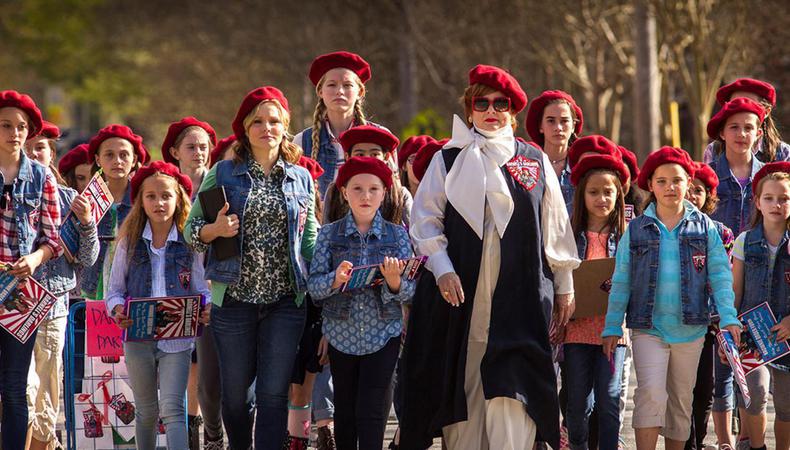
Melissa McCarthy and Ben Falcone’s new movie is proof that comedians should follow their goofiest impulses. Fifteen years ago, when they were training in Los Angeles at the Groundlings, the idea for an outrageous character popped into McCarthy’s head. Wearing a blazer and cropped wig of her own making, she would charge into the theater screaming, “My name is Michelle Darnell and I have $300 million in cash and assets!” remembers Falcone. “And she starts throwing Werther’s candies to the audience. I was, like, ‘Holy shit. This is so great.’ ”
“The Boss,” in theaters April 8, is the result of that godsend of an inspiration. For the domineering titan of industry Michelle Darnell, a character so outrageous she practically demands her own backstory, a feature film was a long-awaited dream come true. “You know, it’s that quick, 15-year movie process,” jokes Falcone.
Universal Studios approached Falcone, who serves as the comedy’s director and co-writer alongside McCarthy and Steve Mallory, after the success of his 2014 directorial debut, “Tammy.” The actor-writer-director is also, incidentally, McCarthy’s husband.
When asked about the difference between “work mode” and “home mode” when crafting a movie together, Falcone says, “I think we’re always, hopefully, in kind of a ‘fun mode.’ We’re talking about comedies; they’re fun to do.” The only reason Falcone and McCarthy refrain from testing out jokes at home, he adds, is that their two children couldn’t care less. “The kids don’t want to hear about it. We just start doing bits with the kids and try to make them laugh, and they try to make us laugh.”
Children feature heavily in “The Boss,” which tracks Michelle Darnell’s fall from financial grace to the brownie empire she builds with her former assistant Claire (Kristen Bell) and a team of cutthroat preteen girls. Renault (Peter Dinklage), archrival and erstwhile lover to Michelle Darnell, attempts to thwart her enterprise. Chaos—and impeccable physical comedy, of course—ensues. Strewn throughout the script are the hilariously emphatic insults that have helped turn McCarthy into a box office empress.
In fact, says Falcone, most of the reason audiences have loved McCarthy’s performances since her Oscar-nominated turn in “Bridesmaids” is her ability to improvise lines. “Sometimes with an improvised take, it’s the first time and you’ve got it, especially if you’ve got two cameras running [on] the person saying it and the reaction coming from it.” Many of McCarthy’s zingers in “The Boss” land thanks to quick cuts to very real responses from her scene partners.
“I’m really greedy with comedy, so if something seems fun I encourage them to try even more and to dig harder, to see how much fun we can get out of it,” Falcone says.
The trick, though, whether it’s the first, second, or third take, is to make the comedy feel fresh within the confines of a two-hour film. “So much of improv can be really long and that’s kind of what makes it funny,” explains Falcone. “Like, one of the characters tells another character literally a two-and-a-half minute story, and it’s hilarious. With most movies you can’t support that over and over again because then your movie would be four hours long.” As both writer and director, Falcone asks his actors to make their bits efficient as well as funny: “Can we make a version that’s 30 seconds long? Because that has a very high probability of being one of the great moments in this movie.”
Falcone wasn’t always such a comedy expert. In his career’s earliest stages, he used Backstage to go out for student film and commercial auditions. “It was a while ago, back when there was less, you know, Internet,” he remembers. “I would look for roles and use it as a tool, just to get anything on my reel.”
One tiny catch: “I never got one! It was a great resource, but I wasn’t very good at my auditions.”
Like this interview? Check out more from creators and Meet the Maker!